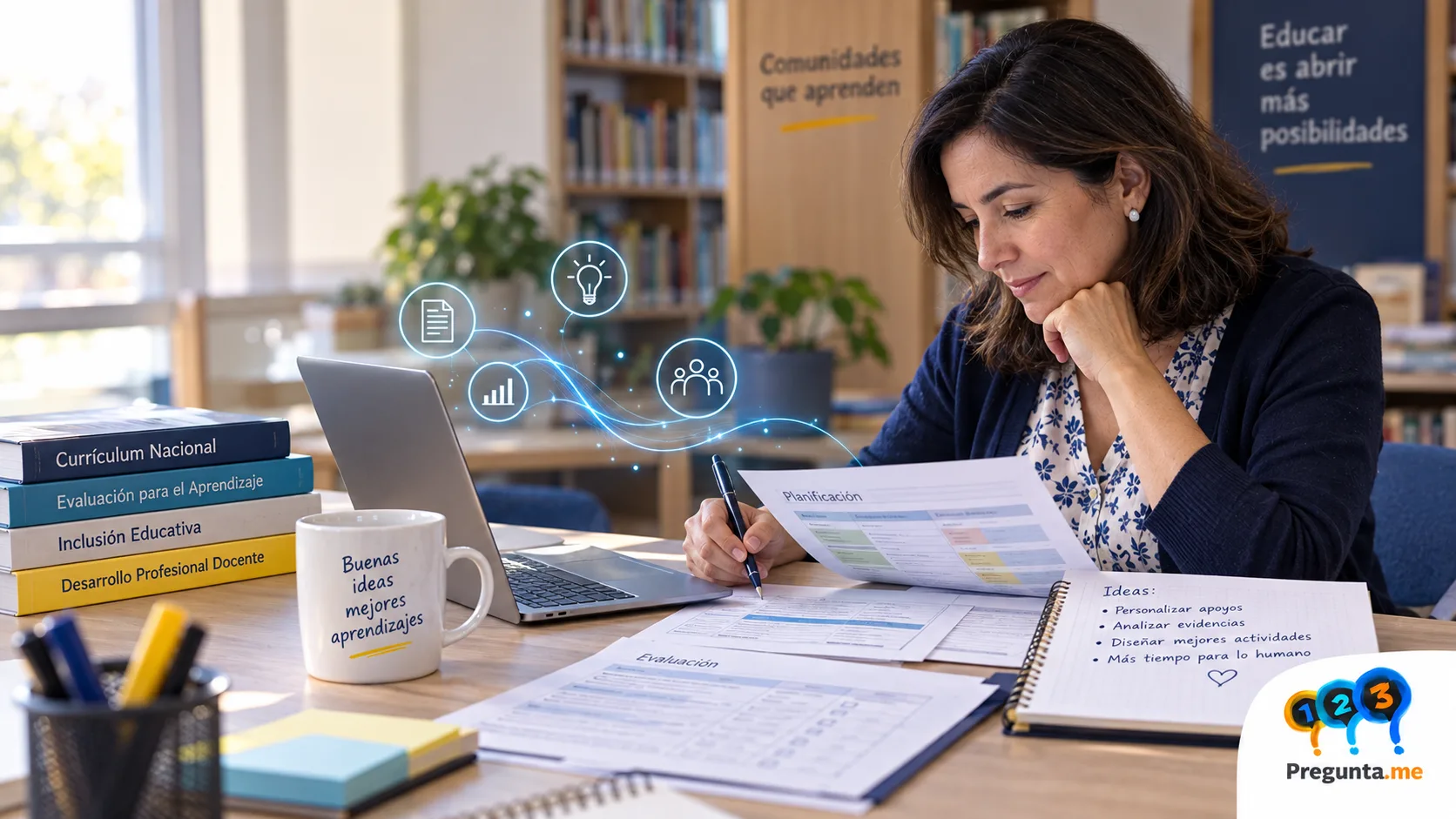
Artificial intelligence is already present in education—not as a distant promise, but as a tool that many teachers, students, and institutions are beginning to explore for specific tasks: planning lessons, creating questions, summarizing content, adapting materials, or generating ideas for activities.
In this context, an important question arises: Will AI replace teachers?
The short answer is no.
The more complete answer is that AI can support many aspects of teaching work, but it does not replace pedagogical judgment, professional experience, or the human connection that sustains learning.
Technology can help produce things faster. But teaching is not just about producing materials.
Teaching involves understanding students, making decisions, guiding processes, interpreting challenges, motivating, adjusting strategies, and building meaning.
That remains deeply human.
AI can save time, but it does not define purpose
One of the greatest opportunities AI offers in education is reducing workload on time-consuming tasks.
For example, it can help:
- create questions for an assessment;
- propose activities based on a learning objective;
- generate examples to explain a concept;
- adapt a guide to different levels of difficulty;
- suggest feedback;
- organize ideas for lesson planning;
- turn a text into a comprehension activity;
- create review resources.
For many teachers, this can make a real difference. Less time spent on repetitive tasks can free up more room to review learning evidence, support students, and design better classroom experiences.
But there is something AI cannot solve on its own: pedagogical purpose.
A tool can suggest an activity, but the teacher decides whether that activity makes sense for their class. It can generate a question, but the teacher evaluates whether it aligns with the learning objective. It can summarize information, but the teacher determines if that summary is clear, relevant, and appropriate for their students.
AI can speed up the work. The teacher gives it direction.
The Value of Teacher Judgment
Every classroom has a unique reality. There are classes with different paces, students with varying levels of support, diverse family contexts, individual interests, and gaps that do not always appear in written plans.
The teacher observes all of this.
They know when an explanation didn’t work, when a question was too complex, when a student needs another example, or when an activity must be adjusted on the fly.
This situated knowledge cannot be replaced by an automated response.
That’s why responsible AI use in education is not about delegating teaching tasks, but about strengthening them.
The question should not be: “How do we get AI to teach for us?”
The question should be: “How do we use AI to make better pedagogical decisions?”
AI to Better Personalize Learning
One of the major challenges in school education is addressing classroom diversity. In a single class, there may be students who progress quickly, others who need more support, and still others who require different challenges to stay motivated.
Personalizing learning is desirable, but it takes time.
This is where AI can be especially helpful.
It can help create different versions of a question, generate alternative explanations, propose reinforcement activities, or design additional challenges for students who have already mastered a topic.
For example, given the same learning objective, a teacher might need:
- a basic-level question;
- an application question;
- an analysis question;
- a review activity;
- a brief guide;
- a study audio;
- video recommendations;
- an explanation for students facing greater difficulties.
Creating all of this manually can be very demanding. With AI assistance, the teacher can generate a first draft, review it, adjust it, and use it according to their judgment.
This process does not eliminate the teacher; it frees them from some operational tasks so they can focus on more important decisions.
Real Risks: Why Simply “Using AI” Is Not Enough
Being optimistic about AI does not mean ignoring its risks.
AI tools can deliver incorrect information, reproduce biases, oversimplify content, or generate responses that seem convincing but are not well-founded.
They can also encourage superficial use if employed only for copy-and-paste purposes.
Therefore, integrating AI into education must be critical, ethical, and responsible.
Teachers need to know how to review outputs, adapt responses to the school context, and teach students to use these tools without ceasing to think for themselves.
At this point, AI literacy becomes a new dimension of teacher and student training. It is not just about learning to use a tool, but about understanding its limits.
AI as a Pedagogical Co-Pilot
A good way to understand AI’s role is to see it as a pedagogical co-pilot.
A co-pilot does not drive alone. They accompany, suggest options, help review choices, and can lighten part of the load. But the driving responsibility remains with the professional.
In education, that professional is the teacher.
AI can propose questions, but the teacher decides which ones to use.
It can suggest a guide, but the teacher adjusts it.
It can analyze results, but the teacher interprets what to do with them.
It can recommend resources, but the teacher knows what their class needs.
This perspective avoids two extremes: thinking AI will solve all educational problems, or believing it has nothing useful to offer.
The key is to integrate it with purpose.
What Does It Mean to Use AI with Educational Purpose?
Using AI with educational purpose means starting from a concrete pedagogical need.
It is not about using technology because it is trendy. It is about asking:
- What learning objective do I want to address?
- What do my students need?
- What kind of resource would help me?
- How will I check if the generated response is appropriate?
- What adjustments should I make for my context?
- How will I use this to improve learning?
When AI is used in response to these questions, it stops being a technological novelty and becomes a real support tool.
This is especially important in the Chilean school context, where teachers need simple, useful solutions aligned with the curriculum.
The Contribution of Platforms Like 123Preguntame
123Preguntame was born from this idea: AI should serve teaching work, not the other way around.
The platform aims to act as an intermediary layer between artificial intelligence models and the real needs of teachers and students.
Instead of requiring technical expertise, it allows users to work within familiar pedagogical categories: grade level, subject, unit, theme, learning objective, and difficulty.
This helps make AI more accessible, more organized, and more useful in the classroom.
The goal is not to replace the teacher, but to provide more tools for creating questions, assessment sets, study guides, review audios, video recommendations, and pedagogical analyses.
All with a clear focus: reducing workload and improving learning experiences.
Conclusion
Artificial intelligence can transform many educational tasks. But its value does not lie in replacing the teacher.
Its true potential lies in better supporting their work.
When used judiciously, AI can help save time, diversify resources, personalize activities, and generate better questions. However, pedagogical intent, contextual interpretation, and human guidance remain irreplaceable.
Education does not need fewer teachers.
It needs teachers with better tools.
And if AI allows teachers to have more time to teach, provide feedback, observe, and support, then it can become a practical ally in improving learning.
References
Mineduc: Guide for teachers: How to use ChatGPT to enhance active learning
https://bibliotecadigital.mineduc.cl/handle/20.500.12365/19453Mineduc: PotencIA el Aprendizaje, Critical and Responsible Integration of Generative AI
https://www.mineduc.cl/mineduc-lanza-guia-para-potenciar-el-aprendizaje-integrando-el-uso-de-la-inteligencia-artificial-en-contextos-educativos/UNESCO: AI Competency Framework for Teachers
https://www.unesco.org/en/articles/ai-competency-framework-teachersUNESCO: Guidance for Generative AI in Education and Research
https://www.unesco.org/en/articles/guidance-generative-ai-education-and-researchOECD: What Should Teachers Teach and Students Learn in a Future of Powerful AI?
https://www.oecd.org/en/publications/what-should-teachers-teach-and-students-learn-in-a-future-of-powerful-ai_ca56c7d6-en.html